
Introduction
Dubai and the UAE are rapidly emerging as global hubs for digital transformation, innovation, smart infrastructure, and advanced technologies. Businesses across industries are increasingly adopting technologies such as Artificial Intelligence (AI), Internet of Things (IoT), automation, cloud computing, and real-time analytics to improve efficiency and make smarter business decisions.
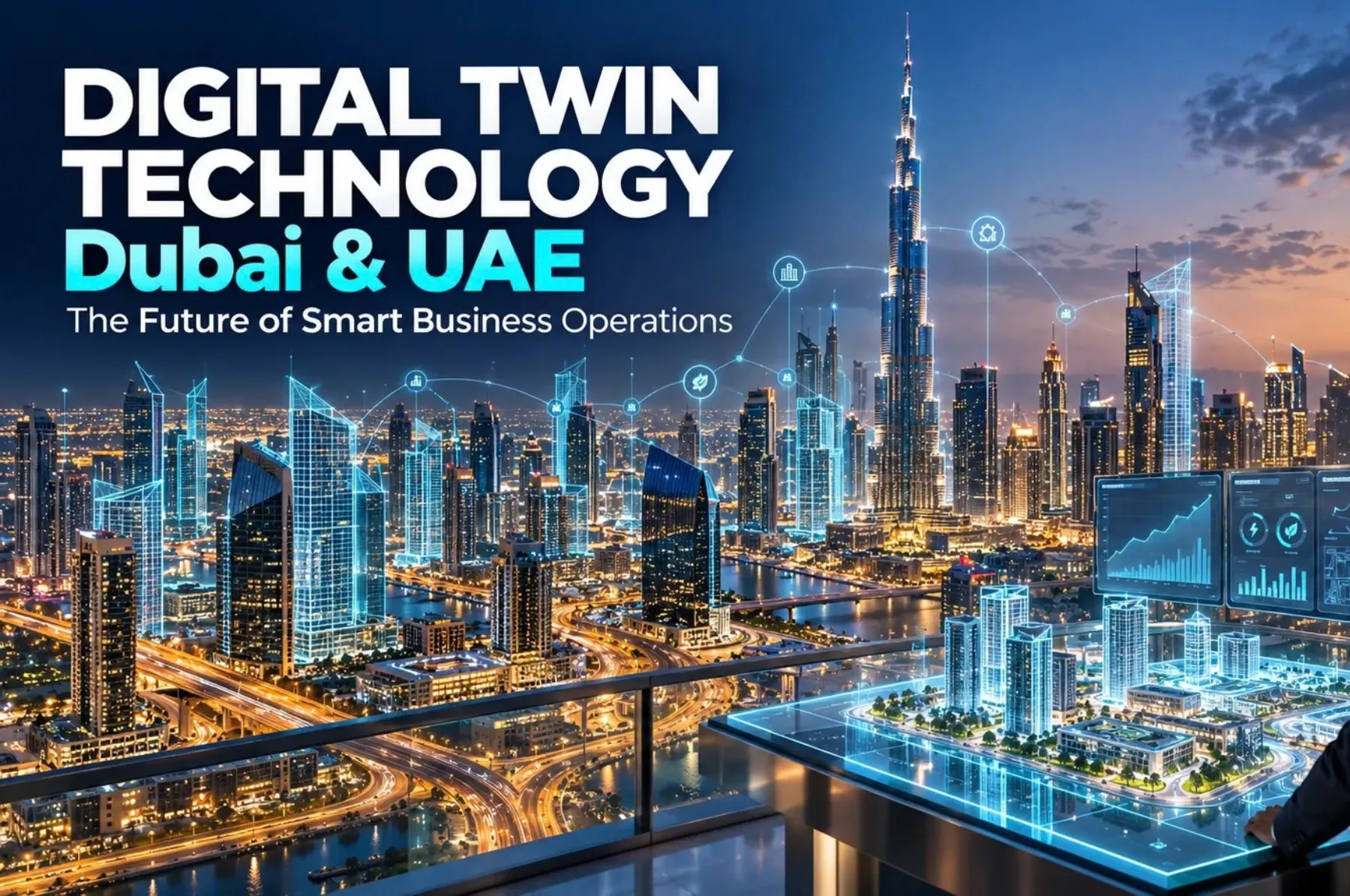
Among these technologies, Digital Twin Technology in Dubai & UAE is gaining significant attention for its ability to connect the physical and digital worlds. A Digital Twin creates a dynamic virtual representation of a physical asset, process, system, or environment and uses real-time data to understand how that physical counterpart is performing.
Unlike traditional digital models that may represent an asset at a particular point in time, Digital Twins can continuously interact with real-world data. This enables organizations to monitor operations, identify potential problems, simulate different scenarios, predict future performance, and optimize processes.
For businesses operating in Dubai and across the UAE, this technology presents opportunities to improve productivity, reduce operational costs, minimize downtime, enhance sustainability, and support data-driven decision-making.
As organizations continue moving toward Industry 4.0 and intelligent automation, Digital Twin Technology in Dubai & UAE is becoming an important component of the next generation of smart business operations.
What Is Digital Twin Technology?
Digital Twin technology is an advanced digital solution that creates a virtual representation of a physical object, asset, process, system, or environment.
This virtual representation is connected to its physical counterpart through data generated by sensors, machines, enterprise systems, and other connected technologies. The Digital Twin can then process and analyze this information to provide insights into real-world performance.
For example, a manufacturing company could create a Digital Twin of a production machine. IoT sensors installed on the machine can collect information such as temperature, vibration, energy consumption, operating speed, and performance. This data can be transferred to the Digital Twin, allowing the business to monitor the machine in real time and identify unusual behavior.
The Digital Twin can also be used to simulate possible changes before they are implemented in the physical environment.
Key Technologies Behind Digital Twins
Several technologies work together to create an effective Digital Twin ecosystem:
IoT Sensors: Sensors collect real-time information from physical assets, machines, buildings, vehicles, and other connected environments.
Artificial Intelligence: AI can analyze large amounts of data and help identify patterns, trends, and potential operational problems.
Machine Learning: Machine Learning models can learn from historical and real-time data to generate predictive insights.
Cloud Computing: Cloud platforms provide scalable infrastructure for storing, processing, and accessing Digital Twin data.
Real-Time Data Analytics: Analytics platforms transform raw data into meaningful information that businesses can use for monitoring and decision-making.
Digital Twin vs. Traditional Digital Model
A traditional digital model generally provides a static representation of an object or system. It may describe how something is designed or expected to operate.
A Digital Twin, on the other hand, is designed to remain connected to the physical world through continuous data flows. This makes it possible to monitor actual performance, analyze changes, conduct simulations, and generate predictive insights.
This dynamic capability is one of the primary reasons businesses are exploring Digital Twin Technology in Dubai & UAE for complex operations and asset management.
Why Is Digital Twin Technology Growing in Dubai & UAE?
The UAE has established itself as a strong adopter of emerging technologies, with Dubai particularly focused on smart infrastructure, digital services, automation, artificial intelligence, and data-driven development.
Businesses operating in this environment are looking for technologies that can help them manage increasingly complex operations while improving efficiency and sustainability.
Digital Twin Technology in Dubai & UAE aligns closely with these requirements because it enables organizations to create connected digital environments where physical assets and processes can be monitored and analyzed through real-time data.
Growing Focus on Smart Cities
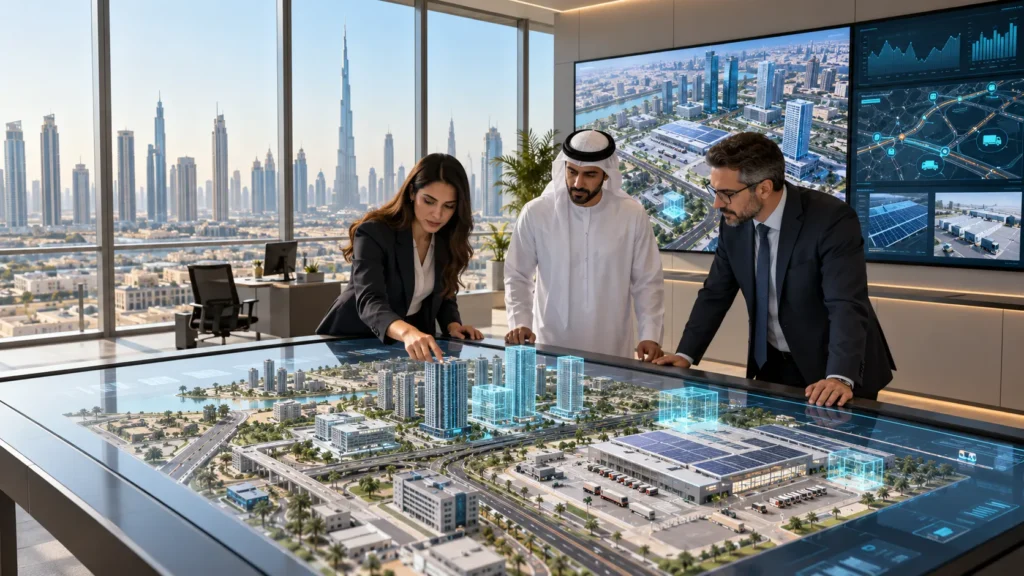
Dubai and other UAE cities are investing heavily in smart infrastructure and connected systems. Digital Twins can support these environments by providing digital representations of infrastructure, buildings, transportation networks, energy systems, and other urban assets.
This can help organizations understand how different systems interact and evaluate potential changes before implementing them in the physical environment.
Demand for Data-Driven Operations
Businesses today generate enormous amounts of operational data. However, collecting data alone is not enough. Organizations need technologies that can transform data into actionable insights.
Digital Twins provide a framework for connecting data from multiple sources and using analytics, AI, and visualization to understand operational performance.
Growth of Industry 4.0
Manufacturing and industrial organizations are increasingly adopting Industry 4.0 technologies, including IoT, automation, AI, robotics, cloud computing, and advanced analytics.
Digital Twins can bring these technologies together into a unified environment, allowing businesses to monitor assets, optimize production processes, and predict potential failures.
Focus on Efficiency and Sustainability
Reducing energy consumption, minimizing waste, optimizing resources, and improving asset utilization are becoming important business priorities.
Digital Twins can help organizations understand how assets and processes consume resources and identify opportunities for optimization.
As a result, the adoption of Digital Twin Technology in Dubai & UAE is expected to continue growing across multiple industries.
Why Is Digital Twin Technology Growing in Dubai & UAE?
A Digital Twin typically operates through a continuous lifecycle that connects physical assets with digital environments.
- Data Collection from Physical Assets The process begins with collecting information from physical assets, machines, buildings, vehicles, equipment, or business processes. Sensors and connected systems can capture information such as temperature, pressure, location, movement, energy consumption, production output, and equipment condition.
- IoT and Sensor Connectivity IoT technologies connect physical assets to digital platforms. Sensors transmit operational information, allowing the Digital Twin to receive updated data. Reliable connectivity is important because the quality and frequency of incoming data directly influence the usefulness of the Digital Twin.
- Data Integration Data from IoT devices can be combined with information from ERP platforms, CRM systems, cloud applications, databases, maintenance systems, and other enterprise technologies. This creates a more comprehensive view of business operations.
- Creation of the Virtual Replica The collected information is used to develop a virtual representation of the physical asset, system, or process. The Digital Twin can represent the asset's structure, condition, behavior, and operational characteristics.
- Real-Time Monitoring Once connected, the Digital Twin can provide real-time visibility into the performance of the physical asset. Businesses can monitor operational conditions and identify deviations from expected performance.
- AI-Powered Analysis and Simulation AI and Machine Learning can analyze Digital Twin data to identify patterns, anomalies, and potential problems. Organizations can also use Digital Twins to simulate different scenarios and evaluate possible outcomes.
- Predictive Insights Historical and real-time data can be used to predict future conditions. For example, a Digital Twin may help identify signs that industrial equipment could require maintenance before an actual failure occurs.
- Continuous Optimization Digital Twins can support continuous improvement by providing organizations with ongoing operational insights. Businesses can adjust processes, resources, maintenance schedules, and workflows based on data-driven findings.
Key Benefits of Digital Twin Technology in Dubai & UAE
The adoption of Digital Twin technology can deliver several operational and strategic benefits for organizations.
Real-Time Asset Monitoring
Businesses can gain greater visibility into the performance and condition of physical assets.
Instead of relying only on periodic inspections, organizations can use real-time information to monitor assets continuously.
Predictive Maintenance
Digital Twins can help businesses identify early signs of equipment problems.
Predictive maintenance can allow organizations to address potential failures before they result in unexpected downtime.
Improved Operational Efficiency
By analyzing operational data, businesses can identify bottlenecks, inefficiencies, and underperforming processes.
This can support more efficient resource allocation and workflow optimization.
Reduced Downtime
Unexpected equipment failures can interrupt production and increase operational costs.
Digital Twins can help businesses detect unusual patterns and take preventive action before major problems occur.
Better Resource Utilization
Organizations can analyze how machines, energy, materials, facilities, and other resources are being used.
This information can help businesses improve utilization and reduce unnecessary consumption.
Cost Optimization
Better maintenance planning, resource utilization, and process optimization can contribute to long-term cost savings.
Enhanced Decision-Making
Digital Twins provide decision-makers with data-driven insights that can help them understand current performance and evaluate possible future scenarios.
Improved Sustainability
Organizations can use Digital Twin technology to analyze energy consumption, resource utilization, emissions, and operational efficiency.
This can support sustainability initiatives and more responsible resource management.
Risk Identification
Digital Twins can help identify abnormal operating conditions and potential risks before they become significant problems.
Faster Business Process Optimization
Organizations can simulate changes digitally before implementing them in the physical environment, helping teams evaluate potential outcomes more efficiently.
Applications of Digital Twin Technology Across UAE Industries
The potential applications of Digital Twin Technology in Dubai & UAE extend across numerous sectors.
Smart Cities
Digital Twins can support smart-city development by creating virtual representations of urban infrastructure and connected systems.
Potential applications include:
- Infrastructure monitoring
- Traffic management
- Urban planning
- Energy management
- Building management
- Environmental monitoring
By combining IoT data, analytics, and Digital Twin platforms, organizations can gain a better understanding of how different urban systems operate together.
Manufacturing
Manufacturing is one of the most promising application areas for Digital Twins.
Businesses can create Digital Twins of machines, production lines, factories, and manufacturing processes.
Potential applications include:
- Production optimization
- Equipment monitoring
- Predictive maintenance
- Quality improvement
- Process simulation
- Energy optimization
Manufacturers can use Digital Twins to evaluate production changes digitally before implementing them on the factory floor.
Construction & Real Estate
Digital Twins can support the entire lifecycle of buildings and infrastructure.
During construction, Digital Twins can help organizations understand project progress and coordinate different systems.
After completion, they can support facility management and building performance monitoring.
Potential applications include:
- Building performance monitoring
- Construction planning
- Facility management
- Energy optimization
- Asset lifecycle management
This makes Digital Twin solutions particularly relevant to Dubai’s rapidly developing real estate and infrastructure environment.
Energy & Utilities
Energy companies and utility providers manage complex infrastructure that requires continuous monitoring.
Digital Twins can provide digital representations of power plants, networks, equipment, and other critical assets.
Potential applications include:
- Power infrastructure monitoring
- Energy optimization
- Asset performance analysis
- Predictive maintenance
- Operational simulation
Logistics & Transportation
Transportation and logistics organizations can use Digital Twins to improve visibility and optimize complex supply chains.
Potential applications include:
- Fleet monitoring
- Route optimization
- Warehouse management
- Supply-chain visibility
- Vehicle performance monitoring
By combining IoT, GPS, analytics, and Digital Twin technology, businesses can gain deeper insights into transportation operations.
Healthcare
Digital Twins can also support healthcare organizations and facilities.
Potential applications may include:
- Healthcare facility management
- Medical equipment monitoring
- Operational planning
- Resource optimization
- Simulation
As healthcare organizations increasingly adopt connected technologies, Digital Twins can become part of broader digital healthcare ecosystems.
Digital Twin Technology and AI: A Powerful Combination
Artificial Intelligence and Digital Twin technology can work together to create more intelligent operational environments.
A Digital Twin provides a connected digital representation and a continuous stream of operational data. AI can analyze this information and generate insights that may not be immediately visible through manual monitoring.
AI and Machine Learning can help Digital Twins:
- Predict equipment failures
- Detect operational anomalies
- Identify performance patterns
- Forecast future conditions
- Optimize processes
- Support automated decision-making
For example, if an industrial machine begins showing unusual vibration and temperature patterns, an AI-enabled Digital Twin can compare the current data with historical behavior and identify a possible maintenance requirement.
Generative AI can further enhance Digital Twin environments by making complex operational information easier to understand. Instead of requiring users to analyze multiple dashboards, AI interfaces could potentially allow decision-makers to interact with Digital Twin data using natural language.
The combination of Digital Twin Technology in Dubai & UAE, AI, and advanced analytics could therefore contribute to more intelligent and proactive business operations.
Role of IoT in Digital Twin Technology
IoT is one of the fundamental technologies behind many Digital Twin implementations.
IoT sensors collect real-world information from physical assets and transmit that information to digital platforms.
For example, sensors installed on industrial equipment can collect information about:
- Temperature
- Pressure
- Vibration
- Energy consumption
- Operating speed
- Location
- Equipment status
This information can then be synchronized with the corresponding Digital Twin.
The more accurate and timely the data, the more useful the Digital Twin becomes.
However, organizations also need to consider data quality, network reliability, device security, and system integration.
When IoT and Digital Twin technologies are implemented effectively, businesses can create connected ecosystems where physical assets continuously communicate with digital systems.
Digital Twin Technology in Dubai & UAE for Smart Business Operations
One of the biggest advantages of Digital Twin Technology in Dubai & UAE is its ability to help businesses transition from reactive to proactive operations.
Traditional business operations often respond to problems after they occur. Digital Twin technology can provide organizations with information that helps them anticipate potential issues.
For example, instead of waiting for a machine to fail, an organization can monitor its condition and identify early warning signs.
Businesses can also create centralized digital environments where teams can monitor multiple assets and processes.
Simulating Business Scenarios
Digital Twins can allow organizations to simulate potential changes before implementing them.
Businesses may evaluate questions such as:
- What happens if production capacity increases?
- How could a process change affect performance?
- What happens if equipment operates under different conditions?
- How can energy consumption be reduced?
- Which maintenance strategy could provide better results?
This approach can reduce uncertainty and support better planning.
Identifying Inefficiencies
By comparing expected and actual performance, Digital Twins can help businesses identify inefficiencies.
Organizations can then investigate the underlying causes and implement improvements.
Supporting Predictive Decision-Making
Digital Twin platforms combined with AI and analytics can help organizations move beyond historical reporting toward predictive insights.
This can support faster and more informed business decisions.
Challenges of Implementing Digital Twin Solutions
Although Digital Twin technology offers significant opportunities, organizations should carefully consider implementation challenges.
Initial Implementation Costs
Developing a Digital Twin ecosystem may require investment in sensors, connectivity, software platforms, cloud infrastructure, data integration, and specialized expertise.
Data Integration Complexity
Businesses often operate multiple systems and databases.
Integrating ERP, IoT, cloud, operational technology, and other systems can be complex.
Legacy System Compatibility
Older systems may not have been designed to communicate with modern Digital Twin platforms.
Organizations may need integration layers or modernization strategies.
Cybersecurity and Data Protection
Connected assets and systems can create additional cybersecurity considerations.
Businesses should implement appropriate access controls, encryption, monitoring, and security policies.
IoT Infrastructure Requirements
Digital Twins depend on reliable data. Poor sensor quality, connectivity issues, or inconsistent data can affect the performance of the Digital Twin.
Data Quality and Accuracy
Incorrect or incomplete data can produce inaccurate insights.
Data governance and validation should therefore be part of the implementation strategy.
Lack of Technical Expertise
Successful Digital Twin implementation can require expertise across IoT, cloud computing, data analytics, AI, cybersecurity, software development, and domain-specific operations.
Scalability
Organizations should design Digital Twin platforms with future expansion in mind.
A solution that works for a single machine may eventually need to support an entire production line, facility, fleet, or enterprise.
How Businesses Can Successfully Adopt Digital Twin Technology
Businesses considering Digital Twin Technology in Dubai & UAE should begin with a clear strategy rather than attempting to digitize everything at once.
Identify High-Value Use Cases
Organizations should identify assets or processes where Digital Twin technology can deliver measurable value.
Examples include equipment with frequent failures, energy-intensive systems, complex production processes, and critical infrastructure.
Establish Clear Objectives and KPIs
Businesses should define what they want to achieve.
Possible KPIs include:
- Reduced downtime
- Improved productivity
- Lower maintenance costs
- Reduced energy consumption
- Improved asset utilization
- Faster decision-making
Integrate Existing Enterprise Systems
Digital Twin platforms should ideally connect with existing ERP, CRM, IoT, cloud, maintenance, and operational systems where appropriate.
Build a Scalable Architecture
Businesses should consider future growth when designing their Digital Twin environment.
The architecture should support additional assets, data sources, users, and applications.
Implement AI and Analytics
AI, Machine Learning, and analytics can transform Digital Twin data into predictive and actionable insights.
Prioritize Cybersecurity
Security should be incorporated from the beginning rather than added later.
Organizations should consider authentication, authorization, encryption, monitoring, and secure device management.
Continuously Monitor and Optimize
Digital Twin implementation should be treated as an ongoing process.
Organizations should continuously evaluate performance, improve data quality, refine analytics models, and expand use cases as business needs evolve.
Future of Digital Twin Technology in Dubai & UAE
The future of Digital Twin Technology in Dubai & UAE looks promising as organizations continue investing in intelligent infrastructure, automation, AI, IoT, and digital transformation.
Digital Twins are expected to become increasingly connected with other emerging technologies.
AI-Powered Autonomous Digital Twins
Future Digital Twins may become more autonomous, using AI to identify issues and recommend or initiate corrective actions with limited human intervention.
Integration with Robotics and Automation
Digital Twins can work alongside robotics and automation systems.
A Digital Twin could potentially simulate robotic operations, optimize workflows, and provide insights into robot performance.
Smart-City Ecosystems
As smart-city infrastructure expands, Digital Twins can provide a digital layer for understanding and managing interconnected urban systems.
Real-Time Simulation and Predictive Intelligence
Advances in computing, AI, and data analytics could make Digital Twin simulations faster and more sophisticated.
Organizations may increasingly use these capabilities to predict outcomes before making operational changes.
Sustainable Business Operations
Digital Twins can support sustainability by helping businesses understand energy consumption, resource utilization, and operational efficiency.
Connected and Intelligent Enterprises
Over time, Digital Twins could become part of broader enterprise digital ecosystems where assets, people, systems, and processes are connected through real-time data.
This could help organizations create more responsive, efficient, and intelligent business environments.
Why Businesses Should Invest in Digital Twin Technology
Digital transformation is no longer only about adopting individual technologies. Businesses increasingly need connected technology ecosystems that can turn operational data into measurable business value.
Digital Twin Technology in Dubai & UAE provides an opportunity to connect physical operations with digital intelligence.
Organizations can use Digital Twins to:
- Improve productivity
- Increase operational efficiency
- Reduce unexpected downtime
- Optimize maintenance
- Improve resource utilization
- Reduce operational risks
- Support sustainability
- Gain greater asset visibility
- Make faster data-driven decisions
- Prepare for future digital transformation
For businesses operating in competitive markets, having better visibility into operations can create significant strategic advantages.
Digital Twin technology can help decision-makers understand not only what is happening today, but also what could happen tomorrow.
Conclusion
The rapid growth of digital transformation across Dubai and the UAE is creating new opportunities for businesses to adopt intelligent technologies. AI, IoT, automation, cloud computing, robotics, and advanced analytics are changing how organizations manage their operations.
Within this evolving technology landscape, Digital Twin Technology in Dubai & UAE is emerging as a powerful solution for connecting physical assets and processes with digital intelligence.
By creating dynamic digital representations of real-world systems, businesses can monitor performance, identify inefficiencies, predict potential issues, simulate scenarios, optimize resources, and make more informed decisions.
From smart cities and manufacturing to construction, real estate, energy, logistics, transportation, and healthcare, Digital Twin applications have the potential to support a wide range of UAE industries.
However, successful adoption requires more than simply creating a virtual model. Businesses need reliable data, IoT connectivity, scalable architecture, cybersecurity, AI capabilities, system integration, and clearly defined business objectives.
As Dubai and the UAE continue to embrace smart technologies and Industry 4.0, Digital Twins are likely to play an increasingly important role in creating connected, efficient, sustainable, and future-ready organizations.
Businesses looking to adopt this technology should start by identifying high-value use cases and developing a Digital Twin strategy aligned with their operational goals.
Ready to explore the possibilities of Digital Twin technology for your business? Partner with experienced Digital Twin solution specialists to design, implement, and optimize intelligent digital environments tailored to your industry and business requirements.
I look forward to seeing how these developments will improve service levels and customer satisfaction in the freight industry!